
Free Resources: Start Building Better Products Today
Explore our collection of free tools, guides, and learning resources to help you integrate quality thinking into your design process.
CASE STUDIES
See the Difference Clarity Makes
From concept development, what engineering really gets and why it matters.
If you’ve ever wondered why engineering ends up with shifting requirements, late‑stage surprises, or a “blank page” at the start of development, these case studies make the answer unmistakably clear.
Each video shows the same product, the same team, and the same goals — but two completely different outcomes:
- Traditional concept development
- Pierce the Design Fog / ADEPT concept development
Side‑by‑side, you’ll see exactly how clarity (or the lack of it) shapes engineering’s success, cost, and speed.
These aren’t theory videos. They’re practical demonstrations of what your team could be handing to engineering.
Engineering Advantage in Equipment Design
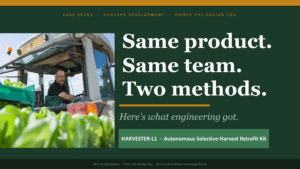
See how a financial value proposition (like a 3‑month payback) becomes either a solid foundation or a costly liability depending on the concept development method.
The MedTech Handshake
Watch how early‑phase risk and HFE work prevent late‑stage safety‑critical failures — and why ADEPT changes everything for regulated teams.

Service Design Case Study
When your product is a promise of service with a 24‑hour clock, engineering needs more than a feature list. This case study shows the difference.

Designing for the Buyer vs. the Return
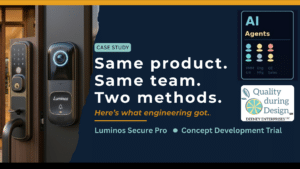
If you design only for the buyer, the end-user drives up the cost of returns, eating away at the business case for your product.
Why these matter
If you lead engineering, product, or quality, these case studies will show you:
- why your team keeps getting incomplete or ambiguous inputs
- how misalignment in the concept phase becomes expensive rework later
- what “good” looks like when cross‑functional teams work with clarity
- how ADEPT turns concept development into a reliable, repeatable process
Watch the case studies → See what your team could be handing to engineering. Bookmark the playlist.
LATE RISK
Move Quality and Risk Thinking Earlier
Risk, reliability, usability, and compliance problems are easier to address before design decisions harden. These resources show what changes when teams bring risk thinking into concept development.
CASE STUDY - MEDTECH
The MedTech Handshake
See how early risk and human-factors engineering change what engineering receives before design inputs are finalized—and why late-stage failures often trace back to concept development.
VIDEO - FMEA
UFMEA vs. DFMEA
Explore two ways to use FMEA in early concept development, how they relate, and why risk analyses work better when they are early, iterative, and connected to user and product decisions.
ARTICLE - DECISION CLARITY
The FMEA Trap
Learn why a team can use sophisticated risk tools and still fail to make the decision in front of them—and how to distinguish risk documentation from risk reduction.
DOWNLOAD - WHITEPAPER
Quality and Reliability Upstream
A broader guide to using quality and reliability early and iteratively in new product development, with practical ways to integrate the work into the process.
DESIGN INPUTS
From Customer Knowledge to Design Inputs
Teams often gather information during concept development but struggle to translate it into decisions engineering can use. These resources show how quality and reliability methods help carry the conversation forward.
PODCAST - DESIGN INPUTS
Beyond Requirements
Explore the transition from customer needs and concept development to technical design inputs, using quality tools to bridge the gap.
PODCAST - QUALITY AND RELIABILITY
Why Your Design Inputs Need to Include Quality & Reliability
See why quality and reliability should be inputs into the design process well before a prototype reaches review.
ARTICLE - EARLY INPUTS
Quality and Reliability are Inputs
A practical reminder that quality and reliability belong well before prototype designs, not only at the approval stage.
PODCAST - PRACTICAL TOOL
Get Design Inputs with Flowcharts
Use flowcharts to help teams gather, organize, and communicate the information needed for better design decisions.
CROSS-FUNCTIONAL WORK
Make Cross-Functional Work Produce Results
Cross-functional teams do not become effective simply by adding more people to a meeting. These resources explore how to structure collaboration so the team produces shared understanding and useful design inputs.
PODCAST - COMMUNICATION
Why Your Cross-Functional Team Isn’t Communicating Effectively
Explore why communication breaks down in the fuzzy front end and how teams can align their perspectives before design decisions harden.
FOUNDATIONS - COLLABORATION
Understanding Cross-Functional Collaboration
Learn how structured collaboration, directed co-work, and focused questions help a team gather design inputs.
PODCAST - MEETINGS
Effective Team Meetings: From Chaos to Cohesion
See how discovery, examination, and prioritization can turn meetings into productive, collaborative working sessions.
PODCAST - DECISIONS
Decision Room Carry
Understand why a cross-functional team can agree on Friday and still fail to carry the decision into the work on Monday.
BEFORE PROTOTYPES
Decide Before You Prototype
Teams often jump into solutions before they have agreed on the problem, the uncertainty, or what they need to learn. These resources examine the moment before commitment.
PODCAST ARC OPENER
Why Do We Jump?
Explore why teams cross from the problem space into the solution space too early—and how deliberate structures help hold the not-knowing.
ARTICLE - DECISION FRAMING
Frame It
Learn how to scope a high-stakes technical decision before testing, so the evidence gathered actually reduces the uncertainty that matters.
INTERVIEW - PROTOTYPING
What Are You Really Trying to Learn?
Consider what a prototype is meant to teach the team before the team commits to building one.
PODCAST - QUESTIONS
The Most Expensive Question You Didn't Ask
Use better questions before commitment to expose assumptions and avoid expensive work built on an incomplete understanding.
QDD Versus Video Series
Get Quality and Reliability Engineering fundamentals from a Product Design Engineering point-of-view.
This video series introduces you to quality and reliability topics from a product design point-of-view. It introduces several topics by comparison in just 8 episodes.
- each episode builds upon the previous ones
- focused on relationships to product design engineering
- "crash courses" - each episodes is less than 15 minutes
- graphics in videos and Venn diagrams in the notes help drive home concepts
- several options: watch the video, listen to the podcast, read the transcript, and/or read the notes.
At the end of the series, you'll have a framework for your own application of Quality Thinking that can help with the success of your designs.


Quality during Design Redux: Test Results Analysis
We're pulling episodes from our archives about test results analysis. Download the latest episode from your favorite podcast provider, and check back here for the next episodes.

Introducing an Online Course
FMEA in Practice: From Plan to Risk-Based Decision Making
link opens in Udemy
Popular Podcast Episodes
Stop Being a Witness to Decisions That You Should be Helping to Shape
You’ve been there. You walk into a design review, a planning session, or a phase gate meeting. You’re ready to contribute, to challenge, to solve. But within minutes, you realize: the decision was already made. The room is a stage, the discussion a script, and you’re just an audience member. This isn’t just frustrating. It’s…

Shannon Cummings on Why Marketing Should Be in the Room Before the First Prototype (A Chat with Cross-Functional Experts)
Dianna Deeney interviews Keven Wang from UnitX about today’s AI in factories and his vision for the future.

Intentional Organizations Don’t Happen by Accident
-The difference between a system that learns and one that simply trudges forward A story I heard recently has stayed with me. A new owner takes over a facility. He’s hands-on, engaged, clearly different from what came before. One of the first things he notices: the break room refrigerator has been broken for weeks. He…
Curated Resources
Below is a list of some of Dianna's favorite resources: books, handbooks, websites, and quality friends. Her recommended materials are either well-worn from years of use or sparked ideas when she read them. She'll continually refresh these lists.
Some podcast episodes feature book reviews. Below are just some of them:


Books:
Bahcall, Safi. Loonshots: How to Nurture the Crazy Ideas That Win Wars, Cure Diseases, and Transform Industries. St. Martin's Publishing Group, 2019.
The author proposes a way of looking at organizational structure and cult of personalities in the advancement of innovative ideas, and what could cause a once innovative company to collapse. Mr. Bahcall is a physicist that worked in the pharmaceutical industry. He brings his scientific point-of-view to his ideas. He also explains and explores his ideas through historical companies, scientific advancements, and inventions.
Boyd, Drew and Jacob Goldenberg. Inside the Box: A Proven System of Creativity and Breakthrough Results. Simon & Schuster, 2013.
Do you need to innovate existing products to the next level? Maybe don’t just start adding things. Instead, use a thought generating approach to re-evaluate what you already have for new applications.
Dhillon, B.S. Life Cycle Costing for Engineers. CRC Press, 2010.
This is a general book on life cycle costing and it includes a lot of references. Use this as a starting point to discover what types of costs may be applicable to your project, then refer to the references to get more information.
Knapp, Jake, John Zeratsky, and Braden Kowitz. Sprint: How to Solve Big Problems and Test New Ideas in Just Five Days. Simon & Schuster, 2016.
These investors help teams develop the surface of new products, from targeted idea or goal on Monday to testing prototypes with users on Friday. They use many Quality tools to manage team creativity to meet these goals.
Lee, Kai-Fu and Chen Qiufan. AI 2041: Ten Visions for Our Future. Crown, 2021.
The author explores where advances in AI may take us by the year 2041. Realistic advances are explored in sci-fi fantasy short stories.
Norman, Don. The Design of Everyday Things: Revised and Expanded Edition. United States, Basic Books, 2013.
About designing everyday products with the user in mind.
Phillips, Jack J. and Patricia Pulliam Phillips. The Value of Innovation: Knowing, Proving, and Showing the Value of Innovation and Creativity. Scrivener Publishing, LLC, 2018.
Learn business speak with ROI (return on investment).
Article: Schirr, Gary. “Flawed Tools; The Efficacy of Group Research Methods to Generate Customer Ideas.” Journal of Product Innovation Management, vol. 29, 2012.
Academic Scholars investigate brainstorming and other methods to generate ideas.
Thesis: Reimert, Michal. "The impact of Additive Manufacturing on the life cycle cost of one-off parts at Thales Hengelo.” University of Twente. 26 May 2017. essay.utwente.nl/72270/1/Reimert_MA_BMS.pdf. Accessed 5 Oct 2021.
See this graduate thesis report for an example of a detailed life cycle cost analysis.
Websites:
Humble, Jeff. "What is the Double Diamond Design Process? For people that want to make sense of design." The Fountain Institute. www.thefountaininstitute.com/blog/what-is-the-double-diamond-design-process, Accessed 8 Nov 2022.
A good explanation of a common model that explains design in terms of cycles of divergent and convergent ideas.
Lauff, Carlye. "Bridging the Gap: Heling People Understand the LUMA System." LUMA Institute, 6 May 2022. www.luma-institute.com/2022/05/06/bridging-the-gap/, Accessed 8 Nov 2022.
"Alternative Worlds" are methods that put the designers into the worlds of those they design for human-centered designs.
Resource Websites:
University of Kentucky
The University of Kentucky libraries posts standards organizations on their Engineering Research Guide. Check it out! Home - Standards & Specifications - Research Guides at University of Kentucky (uky.edu)
Center for the Transformation of Work
This group has a searchable directory of marketplaces that are built to cross-pollinate industries with innovative ideas. https://directory.transformationofwork.org/about Check it out! Maybe you'll solve the next problem (and get paid to do it!).


For hands-on team support:
Explore our workshops and advisory services for organizations.
Graphic attributions: People illustrations by Storyset Engineer Image by DCStudio on Freepik