
QUALITY DURING DESIGN - SERVICES
Design Quality In Before Rework Takes Over
Practical support for product and engineering leaders who need clearer design inputs, stronger cross-functional alignment, and fewer late surprises.
Product teams rarely intend to create design churn. It begins earlier—when customer needs, technical constraints, quality concerns, and cross-functional knowledge have not yet been brought together.
THE PROBLEM
The Hidden Cost of Design Churn and Late-Stage Firefighting
Your team works for weeks on a solution, only to discover during review that it does not meet customer needs, business requirements, manufacturing realities, or quality expectations.
The visible cost is rework. The hidden cost is the time spent revisiting decisions, resolving conflicting assumptions, explaining delays, and asking people to solve problems that should have been surfaced earlier.

Product failure risk
When the team develops before it understands.
Customer knowledge, quality concerns, and technical constraints are not translated into useful design inputs early enough.
.
Approval bottlenecks
When important perspectives enter too late.
Quality, regulatory, manufacturing, or other stakeholders encounter major concerns after key design decisions have already been made.
Internal conflict and silos
When functions work from different assumptions.
Meetings become status updates or conflict-resolution sessions instead of productive working time.
No repeatable process
When every project starts from scratch.
The team depends on individual experience and informal conversations, so important knowledge is difficult to capture and reuse.
WAYS TO WORK TOGETHER
Choose the level of support that fits your situation
Whether you need a focused diagnostic, a hands-on team workshop, or ongoing support, there is a place to start.
FOCUSED DIAGNOSTIC
Design & Quality Snapshot
Get a focused view of where your product-development process is creating avoidable friction—and what to address first.
The process:
- Start with a 20-minute intake call.
- Share a small set of redacted process documents or records.
- Within two weeks, receive three prioritized findings, each with a recommended next step.
- Meet for a 60-minute review call to discuss the findings and map possible next steps.
You do not need to prepare a large document package. Redacted materials are fine, and no NDA is required for the initial review.
Fee: $2,400, credited toward a workshop or Partnership engagement if you move forward. Payment by card is available.
TEAM APPLICATION
Pierce the Design Fog Workshop
A facilitated concept-development workshop for product managers and engineering leaders who need to move from an uncertain product idea to a shared, evidence-informed direction.
Before the workshop, your team has a product idea but lacks shared clarity about the customer needs, product characteristics, and potential problems the design must address.
After the workshop, your team has:
- A shared concept definition
- Prioritized customer benefits and design inputs
- An initial view of customer-impacting symptoms
- A mapped use process
- Documented decisions, open questions, and next steps
- A repeatable process for future concept-development work
ONGOING SUPPORT
Quality during Design Partnership
Ongoing strategic support for organizations that want to embed better product-development practices and build internal capability over time.
Work together through monthly or quarterly support, depending on the organization’s needs and current priorities.
WORKSHOP
Apply Pierce the Design Fog to your actual product.
This is not a generic training workshop. It is a facilitated working session for a cross-functional product team. Your team uses ADEPT and the Concept Space Model to move from an uncertain product idea toward shared, prioritized design inputs.
Private in-person workshop
Two days for one company, up to 25 participants organized in teams of four to five. Travel and lodging are billed at cost when applicable.
- Pre-workshop alignment call
- Book and card deck for each participant
- Facilitation, materials, and team exercises
Private virtual workshop
Four half-day sessions for up to 10 participants, with additional participants available up to 15. No travel costs.
- Miro board setup and digital materials
- Book and card deck for each participant
- Post-workshop digital artifacts and summary
Your actual product
Work on your team's current concept.
Completed outputs
Concept Space Model and prioritized design inputs.
Reusable capability
A plan for your next independent concept session.
WHY THIS APPROACH
Quality and reliability are part of design-not a final checklist.
The Quality during Design approach brings cross-functional knowledge, customer understanding, quality, and reliability thinking into the earlier stages of product development.
Move Upstream
Surface problems when the team is still working in the problem space and has more options for responding.
Work together
Use structured collaboration so critical insights are visible, examined, and translated into useful design inputs.
Stay with the problem
Give the team enough time to understand what it is solving before committing to a solution.
EVIDENCE AND EXPERIENCE
Practical support grounded in quality, reliability, and product development.
Dianna Deeney brings product-development, quality-engineering, reliability, and leadership experience to complex, compliance-driven work.
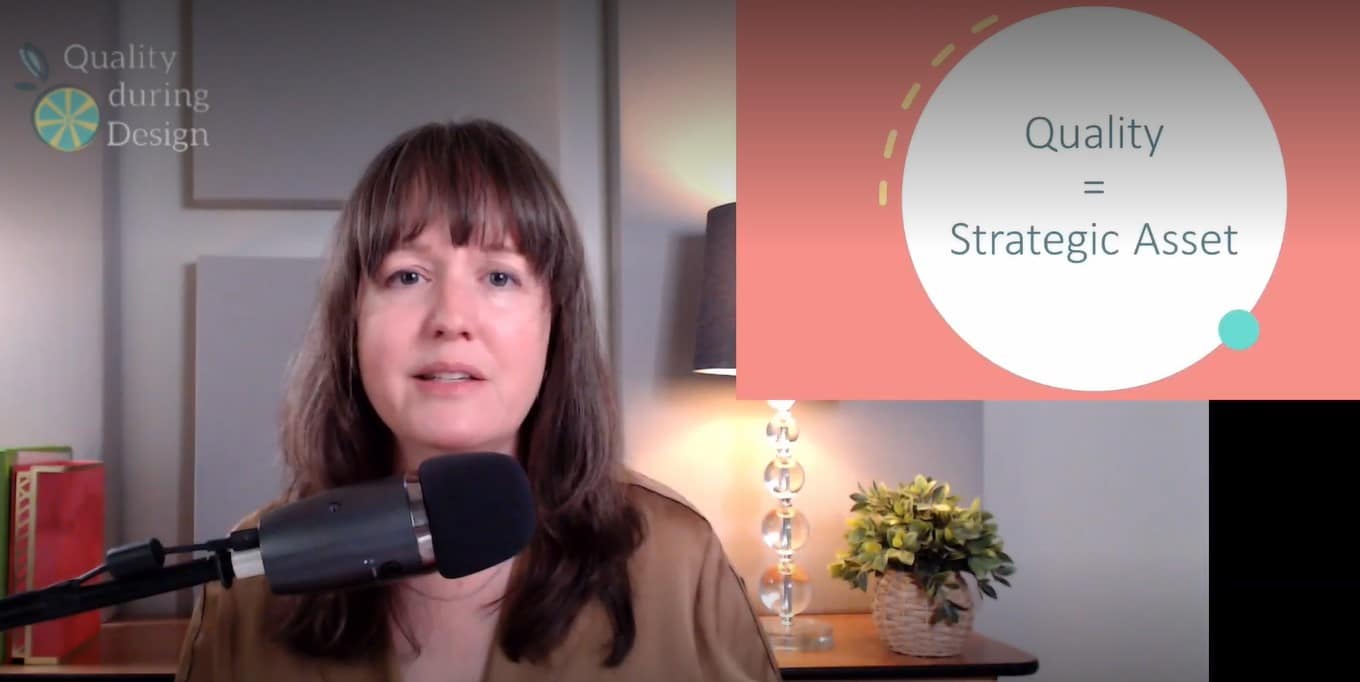
"Dianna has a rare ability to guide professionals through complex, compliance‑driven challenges and make everything feel clearer and more manageable."
Ada Rodriguez, QA Project Manager
"Her presentations encouraged us to think through our problem-solving process and use reliability and stats tools to assess risks and help us make informed decisions."
Rachelo Kay, Quality and Reliability, Calix
START WITH A CONVERSATION
Ready to stop design churn and late-stage firefighting?
No rushed sales pitch and no cookie-cutter solution. In a 20-minute conversation, we will clarify your biggest design-process challenge, determine whether the Quality during Design approach can help, and identify which service option—if any—makes sense.
If we are a good fit, I will send you a custom proposal. If not, I will tell you honestly and point you toward resources that may help.
WHAT HAPPENS NEXT
A straightforward process.
- Book a 20-minute call.
- Discuss your specific product-development challenge.
- Receive a recommendation or custom proposal, if appropriate.
- Decide whether the next step is right for you—without pressure.
Not ready to talk? Get the Strategic Quality Integration Checklist or explore the free resources.
- Subscribe to get the checklist
- Explore free resources.