
Posts by Dianna Deeney

From Tools to Teamwork – 200 Episodes of Rethinking Quality during Design
The throughline of 200 episodes of tools and teamwork: How do teams align on the right problem before they start designing the solution?
Read More
Influence Without the Title, with Jenny Wanger (A Chat with Cross-Functional Experts)
Dianna Deeney interviews Jenny Wanger about influence in product design, without authority.
Read More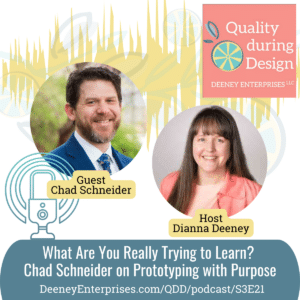
What Are You Really Trying to Learn? Chad Schneider on Prototyping with Purpose (A Chat with Cross-Functional Experts)
Dianna Deeney interviews Chad Schneider on the best way to use prototypes during product design.
Read More
Pierce the Design Fog Named Finalist in the 20th Annual National Indie Excellence® Awards
I’m honored to share that Pierce the Design Fog has been named a Finalist in the 20th Annual National Indie Excellence® Awards, in the Business – General category. The announcement came on June 11th, marking two decades of the NIEA recognizing standout work from self-published authors and independent presses. The NIEA evaluates submissions on both…
Read More
The Most Expensive Question You Didn’t Ask
Sometimes engineering has to do some rework. Usually, it isn’t caused by bad answers. This engineering rework is caused by questions that were never asked or the right questions answered with the wrong tool at the wrong fidelity. Prototyping should be the antidote to that. But for a lot of engineering teams, it’s actually part…
Read More
Local LLMs: Where to Actually Start, with Vincent Deeney (A Chat with Cross-Functional Experts)
Dianna Deeney interviews Vincent Deeney about getting started with Local LLMs.
Read More
Conversations Worth Having: My Podcast Guest Appearances
One of my favorite things about being in this space is the conversations. Real, unscripted exchanges with hosts who care about the same things I do: building better products, leading smarter teams, and making quality a strategic advantage instead of an afterthought. Over the past few years, I’ve had the privilege of being a guest…
Read More