
When Building Gets Cheap, Decisions Matter More, with Ashley Roach
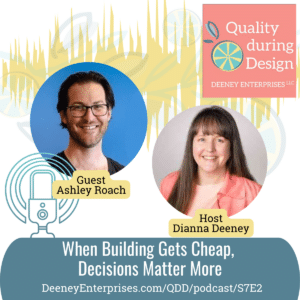 Dianna interviews Ashley Roach about what happens when AI and other fast-prototyping methods make it inexpensive to build and test ideas. The opportunity is speed: teams and individuals can move from an idea to something testable much faster than before. The challenge is deciding what deserves to be built, what needs customer feedback, and which decisions require more deliberate thought.
This interview is part of our series, “A Chat with Cross-Functional Experts.” Our focus is speaking with people who are typically part of a cross-functional team within engineering projects.
About Ashley
Ashley Roach is a product leader and builder who has spent his career turning early ideas into products people use. He was part of the founding team behind Cisco DevNet, which grew into a community of more than 500,000 developers. He later led product for Learn with Cisco, overseeing its applications, user experience, product marketing, and commercial offers across Cisco U. and Networking Academy. Today, Ashley builds independently and writes Beyond the Prototype, a Substack about what one person can realistically ship, operate, and monetize with AI.
What Ashley and Dianna Talk About
The Build Trap
When building becomes faster and less expensive, the constraint changes. In the past, a product idea might have been held back by the cost or risk of creating it. With AI-assisted development and other fast-prototyping methods, it is possible to try many more ideas.
That creates a different risk: continuing to tweak and ship because the building process is rewarding, without enough evidence that the product is valuable to customers. Ashley describes an AI tool challenging him on this exact point. He had been considering when to add billing to a project, but the more important question came first: did enough people have the opportunity to test the system and demonstrate that it was worth paying for?
The lesson is not to build more carefully by default. It is to move from building to learning before investing further in the build.
AI as a Thought Partner
Ashley has also used AI tools to create a more structured set of perspectives around an idea. Within Hermes Agent, he created different personas for roles such as chief of staff, researcher, writer, and CFO. Instead of relying on a single helpful response, he can run an idea through several functional perspectives.
That approach resembles the way a larger organization brings different disciplines into a decision. It can help a solo builder ask questions that might otherwise be missed. But it does not remove the need for judgment. The agents can help organize the thinking; the builder still has to decide what to test and what evidence is sufficient.
Two-Way Doors and One-Way Doors
One of the decision frameworks Ashley uses is the distinction between two-way-door and one-way-door decisions. A two-way-door decision is reversible. You can make the choice, observe what happens, and change direction if necessary. These decisions should not receive the same level of deliberation as decisions that are difficult or impossible to reverse.
One-way-door decisions deserve more care because they create longer-term commitments. Ashley uses examples such as entitlements, billing, and architectural or structural choices. Even within an innovative project, some decisions can lock in future features, user experiences, or operating constraints.
The distinction is a simple mirror for the team: are we spending hours deciding something we could ship and learn from, or are we making a systemic decision that needs deeper consideration?
Innovation Inside a Larger Organization
The same pattern applies when innovation takes place inside a larger company. The processes that protect the existing business are useful for managing risk, governance, and commitments. But they may not be the right operating model for an early, uncertain product.
Ashley describes innovation as something that often needs to be kept separate from the mainstream business long enough to develop. In an early stage, teams may need room to test ideas and find product-market fit. As the work moves toward billing, entitlements, governance, or integration with the larger portfolio, the decisions become more consequential.
That separation does not mean avoiding cross-functional input. It means recognizing that an exploratory project and an established product may need different ways of working.
When Everyone Can Build
AI-assisted prototyping and other fast prototyping methods are also changing who can contribute ideas. Engineers, designers, operations professionals, and support teams may all be able to create a prototype or explore a possible solution.
That raises a practical question: who decides what moves forward? Ashley points to the growing importance of engineers who have good product judgment. When an engineer can take a small idea from validation through delivery within a short cycle, the team can learn faster without requiring every idea to pass through a long handoff sequence.
The broader change is that functional boundaries are becoming more permeable. People can use AI to fill knowledge gaps and work more effectively with adjacent disciplines. Accountability and structure still matter, but the work of exploring an idea no longer belongs to only one role.
A Simple Starting Point: The Opportunity Brief
For a practical Monday-morning starting point, Ashley recommends Marty Cagan’s Product Opportunity Brief. The framework asks basic but important questions:
1. Exactly what problem will this solve? (value proposition)
2. For whom do we solve that problem? (target market)
3. How big is the opportunity? (market size)
4. What alternatives are out there? (competitive landscape)
5. Why are we best suited to pursue this? (our differentiator)
6. Why now? (market window)
7. How will we get this product to market? (go-to-market strategy)
8. How will we measure success/make money from this product? (metrics/revenue strategy)
9. What factors are critical to success? (solution requirements)
10. Given the above, what’s the recommendation? (go or no-go)
These questions may seem obvious, but their value is in making the assumptions visible before more time is spent building. An opportunity brief can provide a quick back-of-the-envelope test for whether a feature or product idea deserves further work.
The opportunity brief and the list of 10 questions are from: Cagan, Marty. “Assessing Product Opportunities.” Silicon Valley Product Group, 13 Dec. 2006, https://www.svpg.com/assessing-product-opportunities.
Key takeaways
Speed changes the constraint.
When building becomes inexpensive, the harder question may be deciding what is worth building and how to get meaningful feedback before continuing.
AI can make thinking visible.
Used as a thought partner or as a set of functional perspectives, AI can help expose questions about customers, value, feasibility, and business models. It does not replace the decision-maker.
Not every decision deserves the same amount of time.
Two-way-door decisions can often be tested and reversed. One-way-door decisions require more deliberate analysis because they create longer-term commitments.
Innovation may need a different operating model.
Early exploration benefits from room to test and learn, while established products need stronger attention to governance, integration, and operational risk.
A simple opportunity brief can interrupt the build trap.
Before adding more functionality, clarify who the product is for, what problem it addresses, and what evidence would show that it is worth pursuing.
Your Challenge This Week
Choose one idea, feature, or project you are considering. Run it through Marty Cagan's opportunity checklist. If it is a two-way-door decision, design a small test and put it in front of someone who can give you real feedback.
Contact Ashley
LinkedIn: https://www.linkedin.com/in/ashleyroach/
Beyond the Prototype: https://substack.com/@beyondtheprototype
B(opens in new tab)
Other mentions by Ashley
Other ideas worth considering for decisions in the face of speed
Decisive by Chip and Dan Heath explores biases in our decisions.
The Pyramid Principle by Barbara Minto explores ways to create arguments and analyze problems.
Books
Working Backwards by Colin Bryar and Bill Carr
Podcasts
Lenny's Podcast: Head of Growth (Anthropic): "Claude is growing itself at this point", Amol Avasare
Moonshots Podcast, with Peter H. Diamandis
B(opens in new tab)
Other podcast episodes you may like:
Season Opener: Why Do We Jump? About the Moment Before We Commit
Predictive Analytics, Machine Learning, AI, and VR in Design Engineering
(opens in new tab)