
The Cracks Between Good Designs, with Mike Fedorov (A Chat with Cross-Functional Experts)
 Dianna interviews Mike Fedorov about the gap between design and operations — the cracks where a design looks right on paper and still comes apart when it reaches reality. Mike spent 26 years in supply chain and operations, and he’s watched the same pattern repeat: the failure isn’t usually a bad call inside a single design. It’s what lives in the seams between the teams, the systems, and the data. This conversation is about naming that pattern, and about what AI can (and can’t) actually do once a design meets reality.
About Mike
Mike Fedorov spent 26 years in supply chain and operations, including 15 years at Mars and 10 years with Accenture. He's helped companies navigate operational challenges and transform complex supply chains while staying closely connected to the realities of day-to-day operations. Today, he's Co-CEO of Applied AI Labs, where he leads using AI to help mid-market companies quickly improve performance without overwhelming their teams.
What Mike and Dianna Talk About
What makes Mike a good person to ask “what goes wrong between design and reality” is that he’s lived on the downstream end. He has watched carefully designed programs stall in the final mile, then gone looking for the root cause in the coordination between teams and systems instead of inside the design itself. That practitioner’s vantage point runs through every answer he gives.
A Design That Looks Right on Paper
Mike tells the story of a major transformation (designed carefully, verified interface by interface) that still stalled for months in its final mile. The root cause wasn’t in any recent design decision. It was a piece of master data created fifteen years earlier and misunderstood, because no one had left behind how it was supposed to work. The thing that stopped the project was decided long before anyone in the room started.
The Root Problem: The Coordination Layer
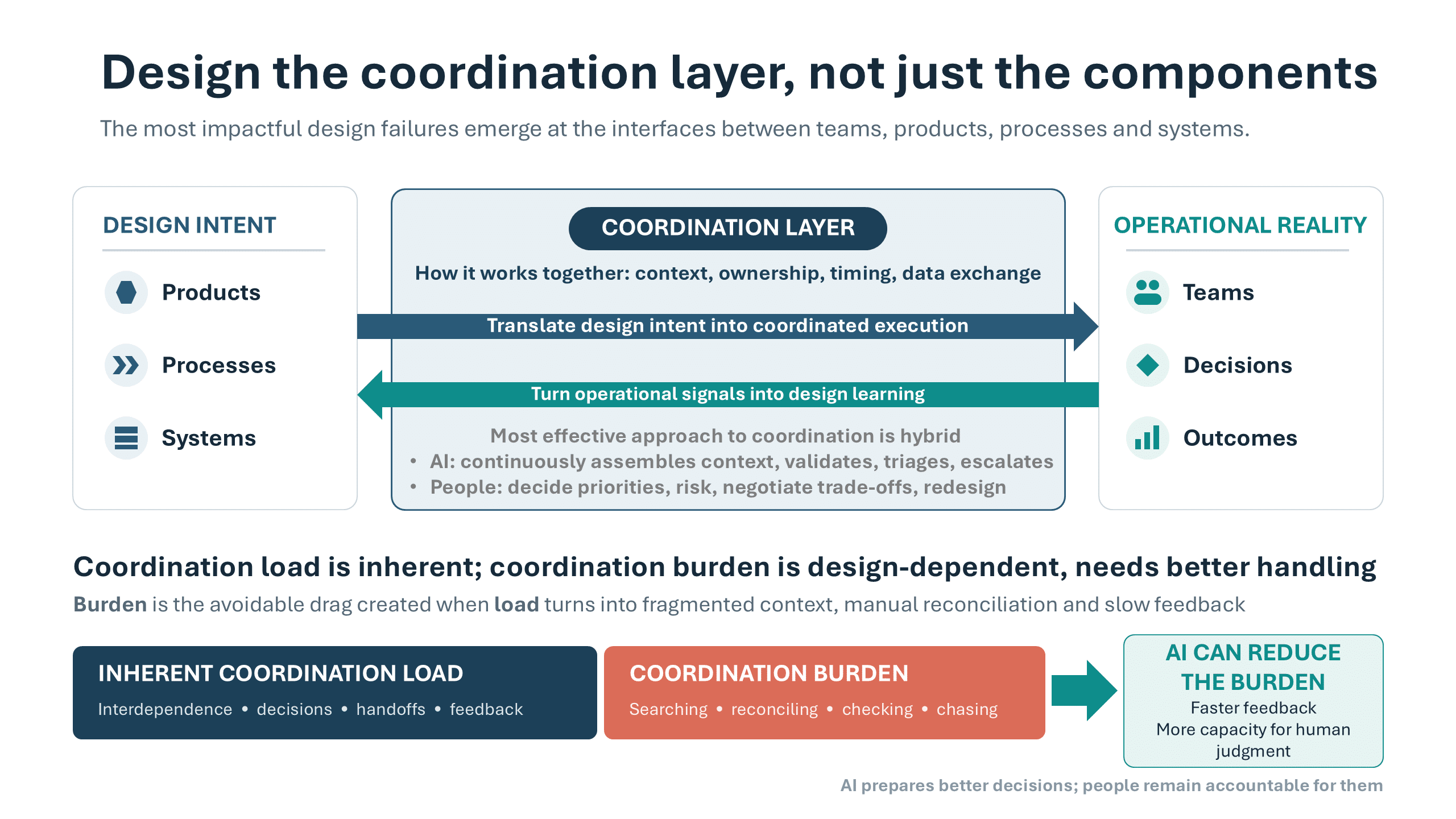
Mike’s observation: people rarely make bad calls inside a well-understood design. The mistakes tend to live in the cracks between the right things — between processes, systems, and teams. As each component gets better and the number of components grows, the connections between them multiply, and that’s where modern failure hides. He calls this the coordination layer: the growing number of places a handoff or data field can silently fail, even while each individual piece improves.
Why the Data Is Always Wrong
Our processes were designed in an era of a few, carefully checked data points. Reality is millions of them, advancing by a decimal here and an idle keystroke there. Yet the systems assume the data can be trusted. Demanding perfect data before acting is really waiting forever. The practical design decision is to build for tolerance — to let small inconsistencies be harmless, detected, or self-corrected. Mike is direct about it: the data is always wrong, so design for that.
What AI Actually Does
AI’s strength is not making decisions; it’s preparing them. It collates thousands of moving pieces, surfaces what looks off, connects the dots, and puts the two or three most important things in front of a human who then decides. Instead of a monthly report and a bug filed after the fact, AI can watch the data front and back, every morning and afternoon, and hand the development team something useful in a minute. It shrinks the loop between operations and design from months to hours.
Why Enterprise AI Fails and the Three Rules That Work
Mike’s account of the 95% failure rate in enterprise AI comes down to a few habits: starting from “how do I use AI?” instead of a real pain, waiting for perfect data, and reaching for a moonshot first. The pattern that works is modest and humble: define the pain where you’re losing money or time, design for imperfect data, and take one small first win you can get in a week or two instead of a ten-year bet.
Key takeaways
The coordination layer is where modern design fails, not inside the design.
Each team and system keeps improving, but the number of connections between them grows the fastest. That’s the seam worth watching.
The data is always a little wrong. Design for it.
Waiting for perfect data is waiting forever. The resilient design tolerates small errors, detects them, or self-corrects — instead of demanding the impossible.
AI doesn’t make the call. It makes the call obvious.
A person with AI beats a person without it. AI’s job is to prepare the decision — prioritize, connect, surface — so a thoughtful human can still decide.
Start small enough to learn.
Define a pain point where money or time is lost and take one modest step that works in days. The humble win feeds the next — the big-bang approach is how pilots die.
Your Challenge This Week
Pick one handover where you’re quietly losing time or money, a place where work moves between two teams. Go watch it for a week before you try to fix it. Notice where the data comes from, what each side assumes, and where it actually breaks. That single observation is often the difference between a coordinated system and a slightly leaky one.
Contact Mike Fedorov
LinkedIn: https://www.linkedin.com/in/mikefedorov/
Email(opens in new tab)Email: [email protected]
Applied AI Labs: https://aalc.ai/
Other podcast episodes you may like:
The Knowledge Your Team Has That Nobody’s Using
Decision Room Carry: Why Your Best Decisions Disappear on Monday