
Four Years Later: Why Quality Still Needs to Move Upstream
In 2022, I published an article about the future of the quality profession. The core message was stark: if quality departments don’t evolve beyond their traditional roles, they risk becoming obsolete.
Now, in 2026, I’m revisiting that piece. Not because I was wrong, but because I was right. And that’s the problem.
The Pattern That Won’t Break
Most organizations still treat Quality as compliance, not leadership. The data confirms this hasn’t improved, and in some critical areas, it’s getting worse.
Quality is losing strategic ground. ASQ’s 2025 Insights on Excellence Benchmarking Report reveals a troubling trend: only 74% of 2024 respondents agreed that “the need to manage business risk drives their pursuit of quality”. This is a 15-percentage point drop from just two years ago. Even more telling: of those who agreed, only one-third completely agreed, meaning two-thirds believe their organizations are failing to adjust based on customer-tied performance indicators.
Organizations are pulling back from strategic change. The same report shows only 33% of respondents said their organization’s quality strategies actually promote achievable objectives. This is a 22-percentage point decrease from 2022. Quality strategies aren’t connecting with reality.
The workforce isn’t prepared for what’s coming. Only 30% of respondents said their organizations effectively prepare their workforces for future necessary skills, meaning 70% feel unprepared. The top skills requiring improvement? Data analytics, problem solving, cross-functional teamwork, strategic implementation, and communication. This is exactly what quality professionals need to move upstream.
Data silos remain a critical barrier. DATAVERSITY’s 2024 Trends in Data Management survey found that 68% of organizations cite data silos as their top concern. This is a 7% increase from the previous year. When quality remains isolated in functional silos, the entire organization suffers.
Cross-functional collaboration is still broken. The same survey revealed that among organizations with defined data architectures, just 32% see better collaboration with business teams. Perhaps most telling: 26% of respondents admitted they don’t have a defined data architecture at all.
These aren’t just quality problems. They’re business problems. Poor data quality leads to poor customer relations, inaccurate analytics, and bad decisions that harm business performance.
What I Wrote Then Still Holds Now
Back in 2022, I argued that the quality profession was at a crossroads. External pressures were mounting. Increased customer communication, big data, expanding regulations, and relentless innovation demands. Businesses had to react quickly, and quality needed to keep pace or get left behind.
I wrote about how quality needs to move out and integrate into other areas of the organization to remain relevant and useful. Not as gatekeepers. Not as the department people “don’t want to fight with anymore”. But as strategic partners.
The warning was clear: if quality professionals don’t adapt, decisions will be made without them. Decisions will be based on gut instinct and abbreviated metrics instead of proper quality methods. The business loses money. Teams lose capability. And quality loses its seat at the table.
But the Companies That Get It Right Are Winning
Here’s what’s different now: we have more proof of what works.
LNS Research’s 2025 report emphasizes that companies that lead with embedded and delivered quality achieve +23% net profit margins and +20% more successful new product launches. The same research shows that companies leading with Delivered Quality and disciplined Operational Excellence are key differentiators. LNS Research’s 2025 Industrial Productivity Index made it unambiguous that quality is a competitive advantage, not just compliance.
Baldrige Award recipients consistently demonstrate this. These aren’t theoretical case studies. They’re real organizations that have documented performance improvements by integrating quality into strategic decision-making. The 2024 Baldrige Award recipients show a clear pattern: organizations that embed quality leadership throughout their operations (not just in isolated quality departments) achieve measurable success.

What do individual practitioners see?
I conducted two polls on Linked-In, Substack, and to my newsletter subscribers. The sample size is low and limited to my network (i.e. biased), but there’s still something to learn from them.
Here are the results:
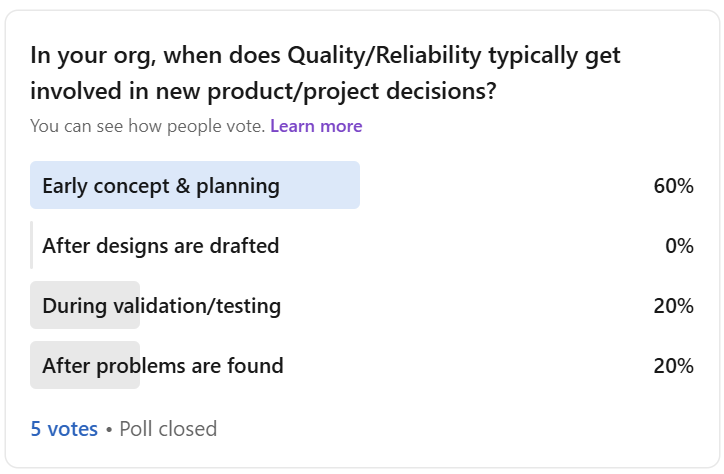
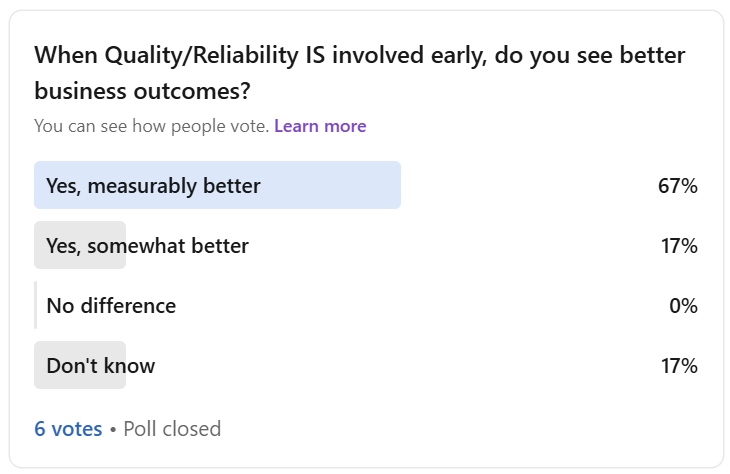
My network shows earlier integration leading to better business outcomes. Some additional insights from responders:
- One key for earlier reliability discussions is NUDS: what’s new, unique, difficult or special? This is a great conversation starter as a gateway to deeper discussions.
- While quality/reliability can be a big influence on the technical outcome, business outcomes are complicated. It can depend on the size of the company, the product being developed, and the maturity of its leadership and systems. So, while there’s influence, it’s not the whole picture.
- Design for Reliability is a generally accepted practice nowadays in some industries. The difficulty lies in measurement. With earlier integration of prevention, how do you know what you don’t know? The key, here, will be to either compare results against predictions based on other, previous projects. Or to measure inputs. For example, I cover measuring the effectiveness and efficiency of FMEAs with tactical and strategic metrics in the Udemy course: FMEA in Practice.
The Shift That’s Still Needed
Quality needs to move upstream. That means:
Into customer and market insight
Understanding the voice of the customer isn’t just about complaint tracking. It’s about monitoring multiple channels, anticipating needs, and shaping what quality means to the brand.
Into early-stage alignment
Quality tools applied early in projects prevent costly issues down the line. Short-term timeline gains from skipping quality activities lead to long-term pain.
Into decision-making, not just documentation
Strong quality leadership should be in the boardroom, helping define brand quality, guiding infrastructure changes, and ensuring data-driven decisions.
What This Actually Looks Like
In my 2022 article, I outlined practical roles quality can play:
- As mentors who help others use quality tools effectively
- As service providers with clearly defined internal customers
- As experts who guide critical decisions
I also emphasized that quality management needs to define what they want to be in the organization and make that clear companywide. Without that clarity, quality initiatives get strangled and people don’t know how to adapt to changing environments.
Putting This Into Practice
This is why I founded the Quality during Design network and wrote the book Pierce the Design Fog. The network brings together the people and ideas. In the book, I lay out the exact frameworks and conversations that help teams move quality upstream before the first line of code is written or the first engineering model is created.
It’s about moving Quality upstream, into product design and the “room where it happens.” It’s about facilitating cross-functional conversations that lead to better data and improved decision-making, not gut feel.
My 2022 article was a wake-up call to some in the quality profession: to remain relevant, you must shift your thinking.
But here’s what matters: I didn’t create Quality during Design just for me to stay relevant. I created it as a way to showcase HOW Quality can be part of product design and early decision-making. My goal is to share the frameworks, processes, and other methods to actually do it: to improve decisions with data and collaboration.
Because it’s one thing to say, “Quality needs a seat at the table.”
It’s another to show up prepared with the tools and approach that make you invaluable once you’re there.
Why I’m Bringing This Up Again
Because the predictions still hold.
The external pressures I identified in 2022 haven’t eased. Instead, they’ve intensified. Customer expectations are higher. Data is bigger. Regulations are tighter. Innovation timelines are shorter.
And yet, too many quality professionals are still out-of-sight, out-of-mind. Shuffled into silos. Working remotely without strategic connection. Unclear on whether they’re mentors, service providers, or experts.
The businesses that figure this out win. They add quality professionals who contribute to profitability, build portfolios of business wins, and become instrumental to success.
The ones that don’t? They’re still fighting with Quality.
Read the Full 2022 Article
I’ve kept the original article where it was published, on CERM Risk Insights. If you want the full context (including specific examples, industry changes like Quality 4.0, and the detailed case for why quality leadership matters). You can read it here.
The question now isn’t whether the future I described is coming.
It’s whether you and your organization are ready for it.
If you lead a quality or product development team at a med device company and this pattern sounds familiar — I’d like to talk about what moving upstream actually looks like for your team. https://calendly.com/dianna-deeney/discovery-call