Creativity Loves Constraints
The best creativity comes from limitations. We explore why frameworks work for ideation in concept development.
My kid got an electronic drum kit recently. We’re about a month into having it and it’s starting to look a little dusty. So, I started searching for videos about drummers on YouTube to share with them. You know, as inspiration. “Isn’t that cool? You should try it!”
It didn’t work to inspire my kid. However, I was the one who got sucked into Drumeo’s series on YouTube. They take tracks of popular songs, remove the drum track layer, and “present” it to guest drummers. My favorite episode so far was with Ashton Irwin.
Drumeo’s Show is all about Creativity within Limits
The guest drummer’s task: fill-in the drum piece.
The catch: they need to do it for a popular song they’ve never heard before.
Every guest drummer is nervous. They’re creating their own version of an already recognizable and popular song. What if the original drummer finds this episode and watches them butchering their song? What will fans think as they compare and judge their on-the-spot performance?
They get to hear the song once, sometimes twice. Some mark up a piece of paper as a sort-of cheat sheet music. Some listen intently and play around with a few licks. They hear the singers, the guitar riffs, the base. There’s structure there. There’s already a beat and a pace. There are solo sections and a chorus.
They work it all out. Then, it’s time to record. It’s fascinating to watch their creativity flow.
What always happens at the end? They’re smiling. They did the best they could. And it was awesome!
The Song is the Framework
Why does this work?
Can you imagine inviting a world class drummer into a studio to just record a few licks? Find a groove? I bet we’d hear great things. But, meh. I’ve watched those YouTube videos, too. While I appreciate their talent, it’s sanitary and lacks the type of creativity that, well, creates new things and pushes boundaries!
This challenge of creating within an existing song works because the song provides a framework.
The song (minus the drums) is guardrails.
It’s a structure within which to create. It’s a limited time. The beat and pace are set. The times when the chorus kicks in and the space for riffs is already defined. There’s even an obvious genre, and the drummers take cues from that, too.
Now, within that framework, they can let loose and be creative. Everything they know goes into that moment. Sometimes it sounds nothing like the original. But it always sounds good.
Frameworks are best when targeted, including in Concept Development
It’s not just Drumeo’s show where this works. This also works in Concept Development.
No Guardrails is No Bueno
Imagine inviting a world-class marketing expert who knows all about your customer and how to successfully market this new product concept. You invite him or her into a room to get their ideas about this big product concept that hasn’t quite taken form, yet.
What type of ideas are you going to get? “Meh” ideas is what you’ll get.
This is just like inviting a world class drummer to play around on the drums. It’s not creative. There’s too much space for their creativity to really shine.
A Prototype Design Introduces Fixedness
Alright. So, what if you wait for the design to have a prototype, then invite the world-class marketing expert to share their ideas about the design? They can change whatever they want.
Ah, “too late!”
They had awesome ideas, but now that they’ve seen your prototype they’re experiencing fixedness, a cognitive bias. Why be creative when it’s already done? Or (if that sounds too lazy), there’s not much creativity they can add to what’s already been decided.
This situation is as if Drumeo played the whole song, with the original drums, to the guests. It would be difficult to unhear the original drum licks, wouldn’t it? They’d start to copy it. Adjust their ideas to fit into what was already done. They would more likely play their version like the original, with maybe a few additions or subtractions.
Frameworks are Just Right
Now, you invite the marketing guru to a concept development working session.
You’re focused on the customer:
- Where they are when they use your product? We check the conditions and their/our assumptions.
- What’s the basic use process, in 7 steps or less? Where do customers start and where do they end up?
- When things go right, what benefits do they experience?
- When things do go as planned, what symptoms might they experience?
This is the Concept Space Model: a framework for team creativity in concept development. The bees are just avatars, there to remind us that we’re not designing features, yet. We’re focused on the customers.
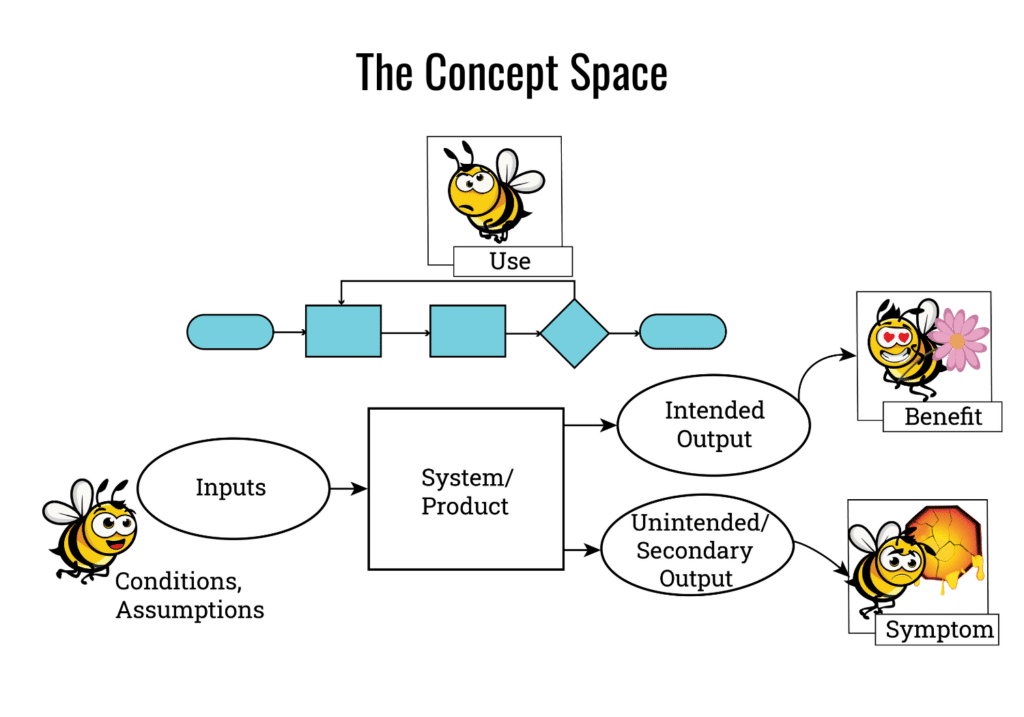
This visual model is like Drumeo’s song without the drum track. It provides guardrails (we’re talking about this customer within this use scenario and these results). It enables creativity of the best talent to work within these guardrails to come up with product concept ideas.
Targeted Frameworks Based on What You Want to Learn is Concept Development Gold
The Concept Space Model offers an opportunity for alignment and a complete project understanding. It’s too high-level and not executable from an engineering perspective. though.
Let’s drill down a little using the Benefit-Impact Template. Here’s how:
Let’s say there’s an intriguing benefit that we want to explore more with this potential product offering.
- Can we express this as having an available feature or characteristic and the impact that has on our customer?
- What product ideas could enable the feature/characteristic to be available to our customer?
- What offerings could drive the positive impact even more?
Finally, given these opens and how we might make it happen, what is the overall effect on our customers?
- Is this something that just has to be part of our product, as a bare minimum?
- Is this a situation where the better we do it, the happier they are?
- Is this so mind blowing, we wouldn’t need to hardly do it at all and they’d still be excited?
This is what working with a template and the ADEPT Team Framework can do for you.
The ADEPT Team Framework is a process for team collaboration, including the steps Align, Discover, Examine, Prioritize, Teamwork. It’s a framework we can use to improve our creativity toward targeted customer benefits of our concept product. If you want to read more about ADEPT, see this article.
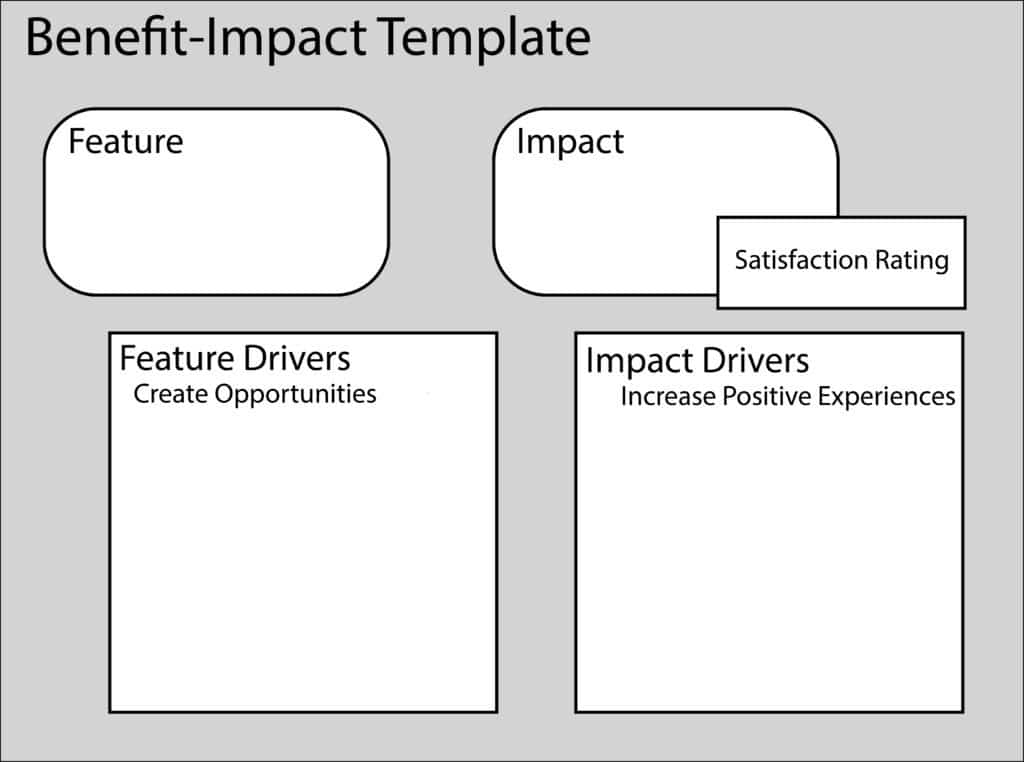
We haven’t even designed anything, yet! We just have an idea. But here we are, developing ideas about potential features and characteristics, and then prioritizing them against how well our product should deliver it. As you can see, the Benefit-Impact Template is easy to replicate, but puts up guardrails for the team to develop ideas. It’s designed to be targeted toward a design that can be engineered.
There are frameworks for exploring symptoms and the use process, too. They’re all explained in Pierce the Design Fog.
The Effectiveness of a Visual Template Depends on its Design and Alignment with the Task at Hand
I explore why frameworks work in Pierce the Design Fog, Chapter 4: “The Art of Using Models to Ignite Ideas”.
Structured idea generation with visual models and templates improves
idea quality. Researchers say visual templates help structure a process,
improve focus, and lead to more and higher-quality ideas. When planning
a meeting or workshop, it’s important to choose or create visual tools that
are right for the specific job. Generic tools may not work as well.
A multinational telecommunications company was seeking ideas
for a five-year product pipeline. They asked employees to take part in
unstructured brainstorming for six months using a generic visual template.
The template prompted them to give their idea a headline, describe it “in
a nutshell,” and then sketch it. There was also space on the template for
employees to list how their idea might relate to existing business platforms.
Over those six months, people generated 93 ideas but only three were
considered high-quality.
Then, company leaders changed their visual template to be more specific
to innovation. The template was about the same size as the previous one but
asked different questions with a single deadline. It still required an idea
name and description, but it also asked employees to identify prospective
customers, their motivations to use the product, and the benefits they would
derive from it.
This time, the process resulted in 11 high quality ideas in a single
session. The change from the generic template to the specific template
represents a more than 300% improvement in the number of high-quality
ideas. In addition, using the structured process with a visual template saved
the company two months of work.
Visual models and templates work. They’re successful because of their association with Activity Theory. Activity Theory is a framework used to understand team activities in educational research, psychology, and organizational studies. According to this theory, using shared and easy-to-understand tools improves teamwork, maintains focus, and prevents confusion. These tools or objects are clear, memorable, and ensure everyone focuses on the same things.
They also work if they are focused on what it is we want to learn. With concept development, we want to get to the point where we can have potential features, characteristics, and offerings and understand how that relates to the customer experience. And we want to be able to do this without actually doing engineering design, yet. Instead, we’re working on the bridge from targeted customer experiences to design inputs and engineering requirements.
A Case Study: an Electronic Maraca
Let’s look at an example of a benefit-impact template for a new product.
We’re developing electric percussion accessories: an electronic version of the maraca. Not a sample pad for the drummer to hit. It’s a hand-held device that can be recorded on the same track as the e-drum kit. This is our product idea. (In real life, this doesn’t exist. So, maybe we’ll inspire the drum kit makers!)

The customer need is to be able to record a maraca sound with the electronic drum kit while mimicking the motion of a maraca.
- A market needs analysis has been done. We’ve concluded there’s indeed a hot market. Bands already use and record sampled percussion. But background singers want to play the maraca as a percussion instrument while also being able to directly record. (I don’t know if this is really the case, but it seems feasible and we’re going to go ahead for our working example).
- A technical feasibility study has been done. We have the in-house capability to do it using mostly OEM components with custom housing that we can make.
- Looking at our portfolio of products, we think we can make it with healthy profit margins, and it fits within our business structure.
Because of all that, the company has approved the project to develop it.
We get our cross-functional team together: the project manager, marketing rep, engineering lead, sales rep, manufacturing, and a paid percussion rep. For our paid customer rep, we’re going to ask for Ashton Irwin because he nailed that Megadeath song and his best friend back-up singer is a maraca player (we can pay her, too).
We ask that the team review the information that led the business to approve this project (marketing needs, technical feasibility, etc.). This should be something they’re doing already.

E-Maraca Concept Development
If you’re an engineer, you’re probably already thinking about gyroscopes, latency, and power sources. But hold on! I implore you to:
First work out the idea using the Concept Space Model using the ADEPT Team Framework to understand how it fits within the user’s environment and expectations.
Before we start, we’re clear that the project manager is going to facilitate and that this is a development activity that feeds into product direction decisions.
- First, we draw out the concept space with inputs and outputs on our shared whiteboard (virtual or physical).
- Next, we consider our users at the input. Where are they (physically, mentally)? What are they assuming as they reach for our product?
- Then, we consider our users at the output. What has happened?
- When it works like it should, what benefits are our customers experiencing? The team prioritizes their top 3 picks for further work.
- When it doesn’t work like expected, what symptoms are our customers experiencing? The team prioritizes their top 3 symptoms.
- Finally, we consider the use process.
- What’s the first thing we think our customers do?
- What’s the last thing they do?
- What are the 3-5 steps they take in using our product to get from start to finish?
Our Team’s Concept Space Results
Here’s the results of our team’s co-working session:
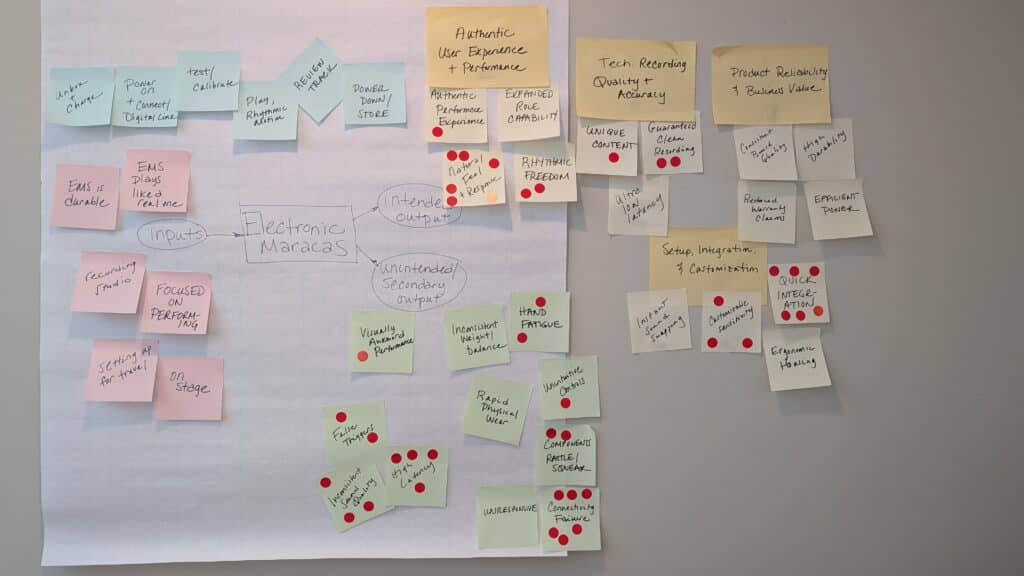
You’ll see the team performed an affinity diagram exercise on the benefits so they could better understand the list. This just means they silently grouped benefits into categories.
Focusing on Benefits
Coming out of our first concept development activity are these categories and potential benefits:
- Authentic User Experience & Performance
- Natural feel & response 🔴
- Authentic Performance Experience
- Rhythmic Freedom
- Expanded Role Capability
- Technical Recording Quality & Accuracy
- Ultra-Low Latency
- Guaranteed Clean Recording
- Unique Content
- Product Reliability & Business Value
- High Durability
- Consistent Build Quality
- Reduced Warranty Claims
- Efficient Power
- Setup, Integration, & Customization
- Quick Integration 🔴
- Customizable Sensitivity 🔴
- Instant Sound Swapping
- Ergonomic Housing
All of these are worthwhile ideas for design inputs. However, the team prioritized three that they want to do a deeper-dive on, highlighted with red dots. So, we decide to further explore those benefits.
Next step: Ensuring impact, collecting drivers, and prioritizing
Further explore team-picked benefits with the Benefit Impact Template, again using the ADEPT Team Framework.
Beforehand, we decide that the engineer is going to facilitate these sessions. We’re not designing in the meeting but instead exploring options that might become part of the design.
We review our prioritization rating scale which will help us categorize features based on customer satisfaction. It helps teams determine if features are mandatory, one-dimensional, attractive, neutral, or negative.
Each benefit gets its own template and goes through its own ADEPT cycle.
- First, we want to turn this benefit into a Benefit-Impact Statement: [Our Customers} can [have this feature/use this characteristic] so they can [experience this positive value]. We add that to the top of the template.
- Next, we list feature drivers, the reasons why the product offers certain capabilities or characteristics. (They are the steppingstones to creating design inputs for the product itself).
- Then, we list impact drivers, the factors that affect the impact of the feature on the user. (Understanding these can help increase the value and positive experiences for the customer and can lead to design inputs or service-related offerings).
- Finally, considering 1 through 3 above, we examine what we have to come to a common understanding of it, and prioritize this targeted benefit against the prioritization criteria.
The team’s results:
For our three priorities, the team completed the benefit-impact statement and template, with drivers and a priority/satisfaction rating.
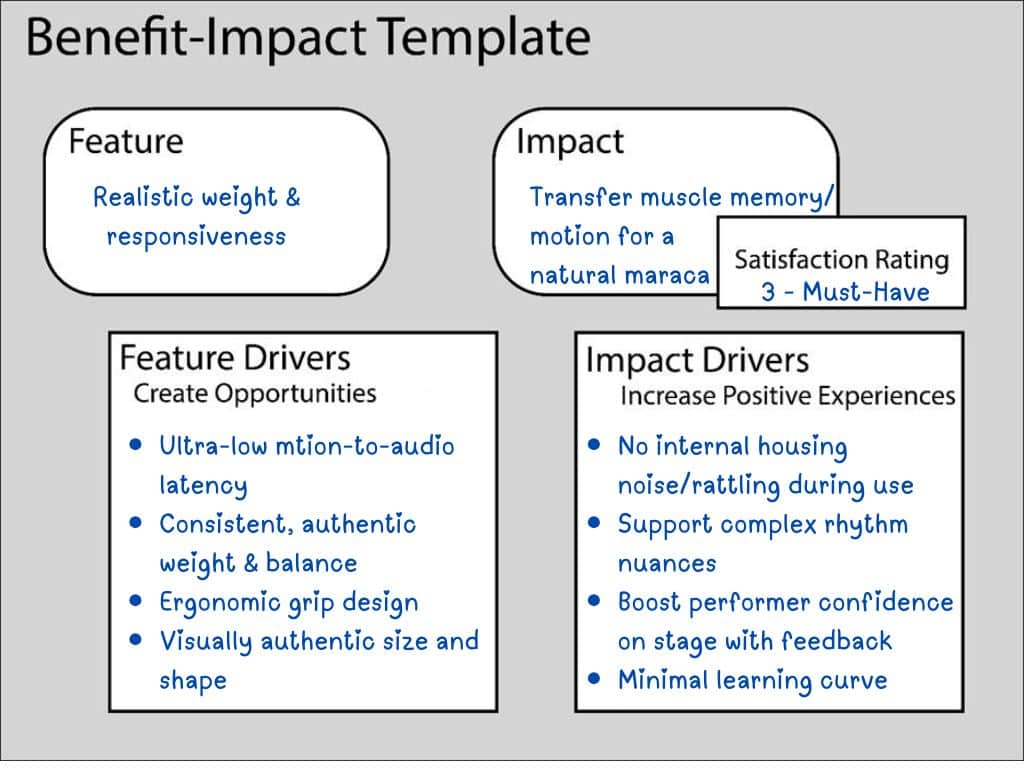
1. Natural Feel and Response
Benefit-Impact Statement: Our customers can use the Electronic Maraca Simulator (EMS) with realistic weight and responsiveness so they can transfer their muscle memory/motion for a natural maraca.
2. Quick Integration
Benefit-Impact Statement: Our customers can connect the EMS to their existing drum module or DAW so they can setup fast and reliably and immediately play.

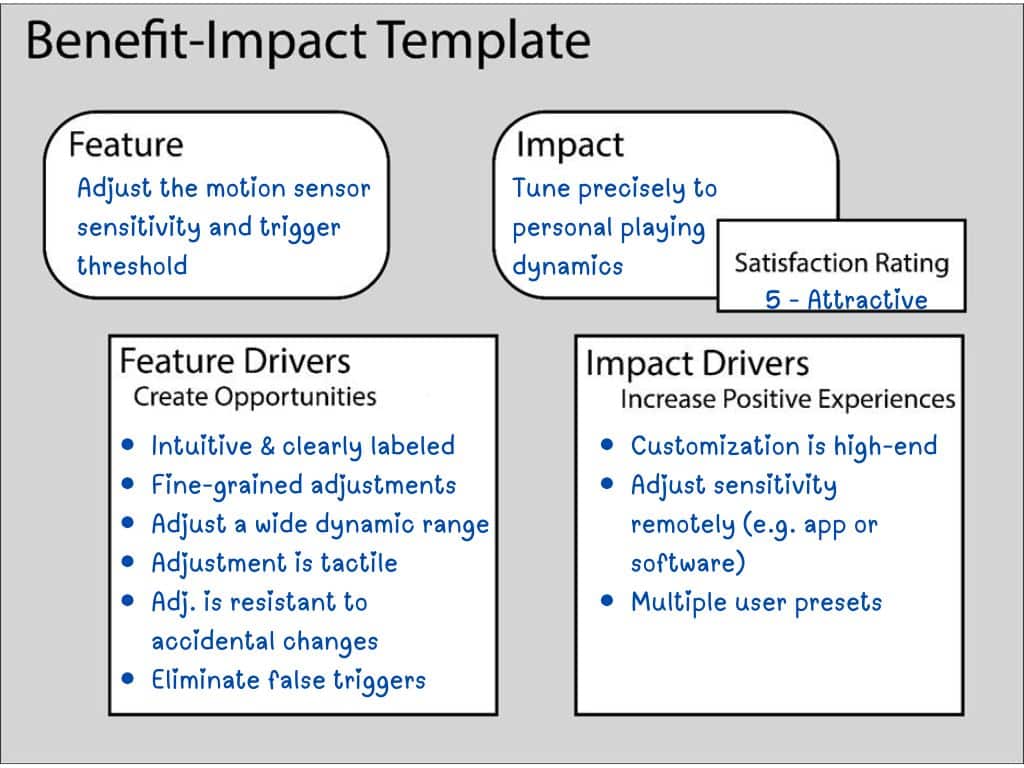
3. Customizable Sensitivity
Benefit-Impact Statement: Our customers can adjust the motion sensor sensitivity and trigger threshold so they can tune the instrument precisely to their personal playing dynamics.
The Team’s Results and How I Would Advise Them
First of all, our team did well to clearly define the benefit as an available feature/characteristic and its impact to the customer. Good job team! 👍If there was a benefit that we couldn’t clearly do that for, then we’d need to evaluate if it was really a benefit. If it has no impact on the customer, then why consider it a benefit?
What we must get right
Since they rated the “Natural Feel and Response” as a must-have, our design MUST be able to deliver on this, at a minimum. If not, our customers will not buy it or recommend it.
We must get the weight, balance, ergonomics, and latency just right, or it’s a failure for our customers, who want to “play” the maracas whether they’re digital versions or not.
Our team has already identified other factors that can increase the positive playing experience even more, like supporting complex rhythm performances. We should take these into considerations in UX and involve customers in our design review loops for this aspect.
What we should work hard to do: the better we do it, the more our customers will love it
Our team rated the “Quick Integration” as one-dimensional. The better we do this, the more our customers will love it.
We’ll want to spend time to design-in features like standardized, common connectivity protocols; plug-and-play; and robust connection ports. And we look to the impact drivers to make the user experience even more special.
What we should offer as a special feature.
The team rated “Customizable Sensitivity” as attractive. This is where we deliver the “wow” factor, the reason people would want to buy it. We don’t necessarily have to implement it perfectly to get great customer reviews.
This could be what makes our e-maraca a huge market win!
Examining Other Areas of the Concept Space Model
Back to our Concept Space Model, we notice there’s a lot of symptoms listed. If our product doesn’t do what it’s intended to do, then it’s going to be a problem making this product a success in the market. Not addressing these could make it a flop. But we’re in concept development – the perfect time to address them!
Because of this, if I were on this team I would be advocating for us to focus on these symptoms. We’d either work to design them out or put in controls to manage them or lessen their impact. Our next step to do this is to use the Symptom-Impact Template with the ADEPT Team Framework. We’d explore the potential symptoms more, similarly to how we did benefits.
With the use process (pictured with the blue Post-it notes), let’s face it head-on. A new e-maraca is going to have a lot of unfamiliar use steps to our customers.
- What areas of our use process are new, different or unknown? Do we need to break them down further (i.e. expand the steps of our process flowchart)?
- Do we actually have two users: the backup singers and the ones managing the electronic signal for recording? We may want to evaluate the users differently.
- We may decide we want to do both a Critical to Quality analysis and a Value-Added flowchart analysis to design an e-maraca that bandmates will love to play.
All of these additional tools are outlined in Pierce the Design Fog. And all are important aspects of concept development.
What results from the work
E-Maracas: are they the future of band recording?
If this were a real use case, I would feel more confident jumping into this project after having done just the Concept Space Model and the Benefit-Impact Template with my team.
Frameworks are used as guiderails to enhance team creativity. They’re targeted for discovery without design; to provide context without definition; and, to ideate enough to bridge the gap between idea and engineering design.
Not only did this exercise identify usable ideas within a realistic realm, but the activities also gave us focused questions for follow-up. It highlighted areas that we need to do more homework to better understand. We were able to do all of this really early with just an idea – not a prototype or engineering design.
Why Frameworks Matter: The Drumeo Lesson
Just like those nervous drummers facing an unfamiliar song, product teams often freeze when given too much freedom or too little structure. But give them the right framework and watch them thrive. Give them guardrails that focus creativity without dictating the solution.
The Concept Space Model and Benefit-Impact Template work because they solve the Goldilocks problem of ideation: they provide just enough structure to channel your team’s expertise toward customer value, without the fixedness that comes from premature design decisions.
Your cross-functional team already knows their parts. They’re world-class at what they do. They just need the right framework to play together, to create something that resonates with customers before a single component is specified or CAD file is opened.
That dusty drum kit in my house might not have inspired my kid yet, but watching those drummers work within constraints reminded me why great products don’t come from blank slates or rushed prototypes. They come from teams who know where to focus their creativity.
Start Here: Your First Concept Development Session
Ready to try this with your team? Here’s how to run your first framework-based concept development session:
1. Pick one active project in early stages (before detailed design, after business approval) Choose something where you have a product idea but haven’t locked into specific features yet. If you’re already in CAD, it’s not too late, just harder.
2. Gather your cross-functional team for 90 minutes (minimum: PM, engineering lead, marketing/sales rep) Block the time. Make it sacred. This isn’t a status meeting, it’s a creation session.
3. Start with the Concept Space Model Draw it on a shared whiteboard (physical or virtual). Spend 20 minutes on each focus area:
- Inputs: Where is the customer when they reach for your product? What are they assuming?
- Process: What are the 5-7 steps from start to finish in using your product?
- Outputs: When it works, what benefits do they experience? When it doesn’t, what symptoms occur?
4. Prioritize your top 3 benefits Vote with dots or discuss. Pick the ones that matter most to customer success. These become your deep-dive targets.
5. Explore one benefit with the Benefit-Impact Template Take your #1 benefit and spend 30 minutes filling out the template:
- Turn it into a Benefit-Impact Statement: “Customers can [have feature/characteristic] so they [experience this positive value]”
- List feature drivers (how the product can deliver this)
- List impact drivers (what maximizes the positive experience)
- Rate it: Must-have? One-dimensional? Attractive?
If this first session feels productive, schedule time to work through your other prioritized benefits and symptoms. You’re now doing real concept development by bridging the gap between “we should build this” and “here’s what engineering needs to design”.
Want Help Implementing This?
Reading about frameworks is one thing. Applying it to your actual product with your cross-functional team is another.
- Pierce the Design Fog Workshop helps your team learn and apply these frameworks to YOUR real project—in just 2 days. You’ll leave with actionable design inputs and aligned priorities. Learn more and schedule a discovery call: https://calendly.com/dianna-deeney/discovery-call
- Listen to the podcast series. Get it for free at PierceTheDesignFog.com.
- Read the full playbook, Pierce the Design Fog. It contains detailed templates, facilitation guides, and case studies. Get your copy.