
Customer Discovery Across Product Stages, with Ashley Phillips
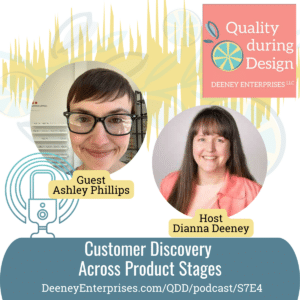 Dianna interviews Ashley Phillips about how customer discovery changes across startups, hypergrowth teams, and established products. The customer may remain the same, but the environment around that customer can change: expectations evolve, workflows shift, and the risks of making a change may become much higher.
This interview is part of our series, “A Chat with Cross-Functional Experts.” Our focus is speaking with people who are typically part of a cross-functional team within engineering projects.
About Ashley
Ashley Phillips is a product leader who's built products at some of the most recognizable names in consumer tech and fintech: Groupon, Venmo, PayPal, and more. Across her career she's launched B2C and B2B experiences at marketplaces, fintechs, and consumer startups, from early-stage teams to hyper-growth companies and big, established products. She's led products through very different outcomes and phases, which gives her a grounded view of product discovery that most people don't get.
What Ashley and Dianna Talk About
When Customers Use the Product Differently Than Expected
Customer discovery can reveal more than whether a product idea is attractive. Once people have something real in their hands, they may find uses the team did not anticipate.
Ashley describes the launch of a Venmo debit card. The initial hypothesis was that people would use money sitting in their Venmo balance as “found money” for purchases. Customers did use it that way, but they also developed another pattern: prepaying someone through Venmo before that person put a card down for a shared meal. The team learned from what customers actually did, not only from what they had said they would do.
That is one reason discovery continues after launch. Usage can reveal new features, new product directions, or even new business lines.
Customer Assumptions Can Become Stale
A team may believe it understands its customer because the product has been around for years. But the customer’s surrounding environment may have changed. The demographic may be stable while expectations, technology, workflows, and competing experiences continue to move.
Ashley points to changing expectations around interfaces and technology. People who once downloaded an app for a particular task may now expect voice, chat, or an agent-based interaction. The assumption about who the customer is may still be accurate, while the assumption about what that customer expects from the product is no longer current.
The same pattern can appear in established medical or industrial products. The product may remain consistent, but the machines, procedures, or working conditions around it may change. Those surrounding changes can alter what customers need from a product that once seemed well understood.
Discovery Across Startups, Hypergrowth, and Established Products
Discovery is not the same activity at every stage. In an early-stage software company with few customers, a team can put something in front of people quickly and iterate with relatively low risk. In a larger or more established product, the team may have more customers, more compliance requirements, more operational dependencies, and more consequences if a release goes badly.
Hardware adds another layer. Ashley describes working on Aura Frames, where the experience depends on both software and physical components. A software update can often be released and corrected more easily than a physical design change. Buttons, touch bars, springs, physical mechanics, and the relationship between the app and the frame all require attention before the product reaches customers.
The need for speed does not disappear in hardware. It has to be balanced with the higher cost and risk of getting a physical product wrong.
Get Real People Involved
Ashley’s consistent advice is to talk to people directly and get something real into their hands whenever possible. A prototype can be software on a screen, a hardware mockup, or a 3D-printed object that is not yet representative of the final product. It does not need to be perfect to generate useful learning.
Direct conversations also provide something that a persona or a summarized research report may not. Ashley describes establishing a regular customer conversation cadence at Aura, inviting people from product, design, research, and engineering to participate. The goal was not always to test a specific feature. Sometimes the team simply asked customers how they heard about the product, how they used it, and where it lived in their homes.
That direct contact helps teams remember that the customer is a person rather than an abstract profile on a slide.
When Resistance Is a Signal
People who have been working on a product for a long time may respond to a new idea with, “We’ve already tried that.” Ashley does not treat that reaction as proof that the idea should be dismissed. It may be a signal to examine why the previous attempt did not work and whether the conditions have changed.
The same applies to personal certainty. Product managers, designers, and engineers can become attached to a hypothesis and begin treating it as a fact. Staying open to evidence requires a willingness to discover that something believed to be true is not.
Engineers and Customer Discovery
Engineers do not need to become full-time researchers to benefit from customer contact. Ashley recommends asking to participate in existing user research, listening to support interactions, or spending time with the people who use internal tools and serve customers directly.
Seeing what happens on the ground gives engineers a perspective that is different from a product brief or a distilled research summary. It can help them make better decisions about what they are building and understand the consequences of technical choices in the user’s actual environment.
A Monday Habit for Staying Honest
Ashley’s practical habit is to look at usage metrics every Monday. The metrics are signals: retention, user activity, and funnel behavior can show that something is happening. Direct conversations with users can help explain what is happening and why.
The two forms of information work together. Regularly reviewing both the data and the customer’s words helps a team notice when an assumption is holding, changing, or becoming stale.
Key takeaways
Discovery continues after launch. Once customers have something real to use, their behavior can reveal new uses, new needs, and new product opportunities.
A stable customer segment does not mean stable customer expectations. The surrounding environment, technology, workflows, and interface norms can change even when the target market appears unchanged.
Hardware requires a different balance between speed and certainty. Physical design choices are often more difficult to reverse than software changes, so discovery and testing become even more important.
Prototypes create better learning when they reach real people. A prototype does not need to be final to reveal useful information about behavior, usability, and need.
Resistance can be a signal. When a team says, “We’ve already tried that,” the response can be an invitation to examine what changed and why the earlier attempt did not work.
Metrics and conversations answer different questions. Usage data can show that something is happening. Talking to users can help explain what is happening and why.
Your Challenge This Week
Choose one customer assumption your team is relying on. Review one current usage metric, support pattern, or piece of direct customer feedback. Ask whether it confirms the assumption, complicates it, or suggests that the surrounding environment has changed.
Then get closer to the source: join a customer interview, listen to a support interaction, or observe someone using the product.
Ways to reach Ashley
LinkedIn: https://www.linkedin.com/in/ashley-phillips-4184536/
Double Good | Easy Online Fundraising Platform
Ashley's podcast "Notes from Chicago": Notes from Chicago - YouTube
B(opens in new tab)
Other podcast episodes you may like:
Season Opener: Why Do We Jump? About the Moment Before We Commit
Two Ways We Jump: Speed and Certainty
How to Self-Advocate for More Customer Face Time (and why it’s important)
(opens in new tab)